
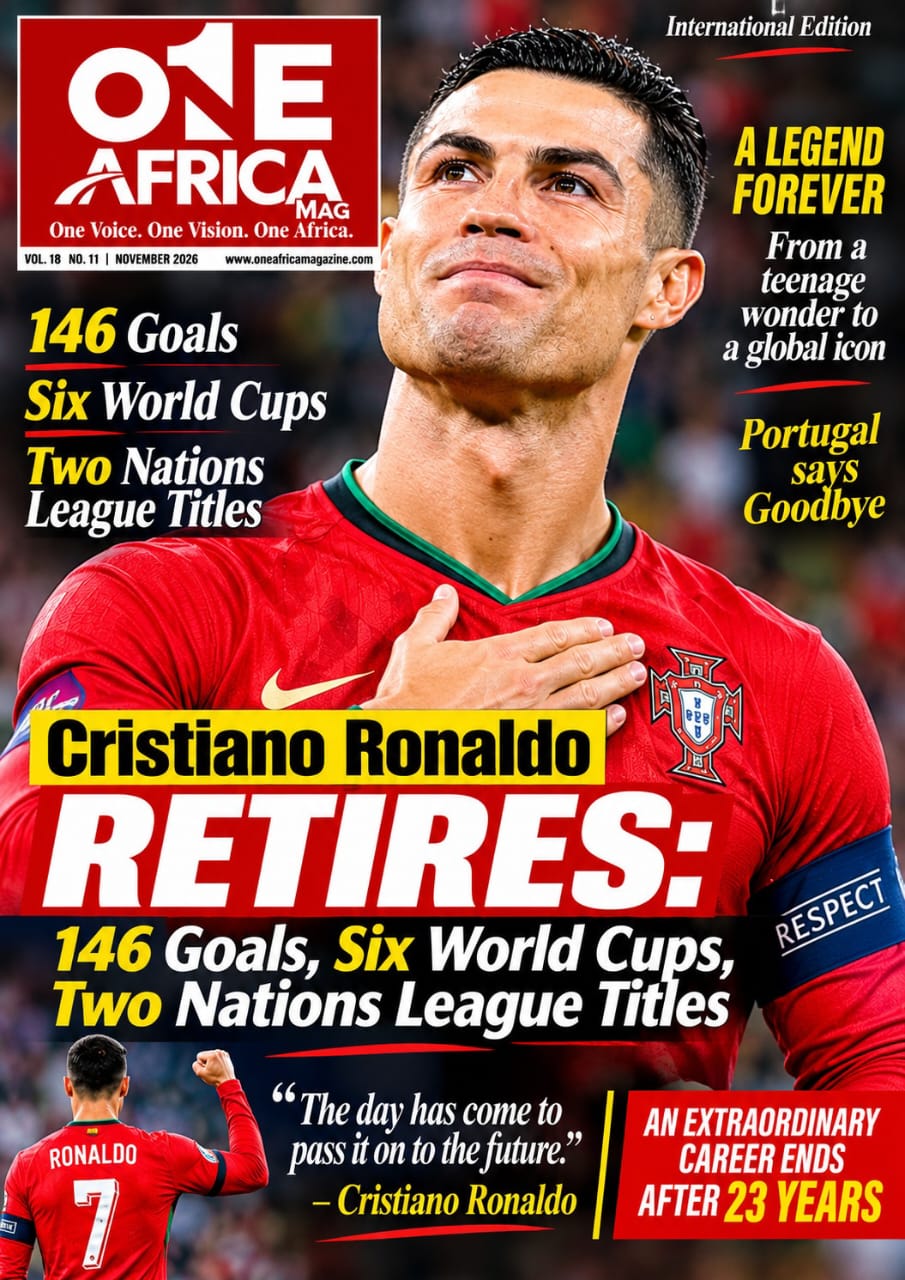
Cristiano Ronaldo has announced his retirement from international football at the age of 41, bringing to an end a remarkable 23-year career in which he became Portugal’s greatest goalscorer, most-capped player and one of the most influential figures in the history of the game.
The five-time Ballon d’Or winner confirmed his decision on Thursday, November 5, 2026, in an emotional video message shared on social media, saying the time had come to surrender the famous No. 7 shirt he had worn with distinction since making his international debut in August 2003.
His departure closes an extraordinary chapter that included a European Championship triumph, two UEFA Nations League titles, six World Cup appearances and a record 146 goals in 234 international matches.
The announcement ends months of speculation about his future with the national team and comes after a disagreement with Portugal head coach Jorge Jesus during the previous international break.
In his farewell message, Ronaldo reflected on the responsibility of representing his country and the emotional significance of wearing Portugal’s colours.
“The day has come back for me to hand back the number 7 shirt of our national team. I never felt it belonged to me alone. But for 23 years I had the privilege and the responsibility of wearing it, defending it, and carrying it with me into stadiums all around the world,” he said.
“Today, the time has come to pass it on to the future. It was not an easy decision. Because some decisions are not made with the mind alone. They are also made with the heart.
“A journey that began in August 2003 and changed my life forever has come to an end.”
He said his memories of international football extended beyond goals, records and trophies, highlighting the connection he developed with Portuguese supporters, including those living abroad.
“I see people. I see the Portuguese people living abroad who, for 90 minutes, felt a little closer to home. I see millions of Portuguese people I have never met but who became part of my life. Because at the end of the day, football is so much bigger than a game. Football is about people.”

From teenage prodigy to Portugal’s greatest football icon
Born on February 5, 1985, on the Portuguese island of Madeira, Ronaldo rose from modest beginnings to become one of the most recognisable sporting personalities in the world.
His international journey began on August 20, 2003, when he made his senior debut against Kazakhstan, aged 18.
At the time, he was an exciting young winger whose pace, technical ability, confidence and willingness to take on defenders had already attracted attention at Sporting Lisbon and earned him a move to Manchester United.
His first major international tournament came at Euro 2004, hosted by Portugal. Ronaldo announced himself to the international audience with impressive performances, scoring against Greece in the group stage and the Netherlands in the semi-final.
However, Portugal’s dream of winning its first European Championship ended in disappointment when Greece defeated the hosts 1-0 in the final.
Ronaldo was visibly emotional after the defeat, a moment that would become one of the defining early images of his international career.
Two years later, he helped Portugal reach the semi-finals of the 2006 World Cup in Germany, where they lost to France.
His performances established him as one of the most exciting young footballers in Europe and marked the beginning of an international career that would span generations of players.
Euro 2016: The historic breakthrough
The defining achievement of Ronaldo’s international career came at Euro 2016 in France, when Portugal finally won a major international tournament.
Having suffered the disappointment of the 2004 final on home soil, Ronaldo returned to the European Championship determined to lead his country to glory.
Portugal’s campaign was far from straightforward. They struggled during the group stage, drawing all three matches against Iceland, Austria and Hungary before progressing to the knockout rounds.
Ronaldo nevertheless played a decisive role, scoring important goals and providing leadership as Portugal advanced.
In the final against hosts France at the Stade de France, his dreams appeared to have been shattered when he suffered a knee injury following a challenge by Dimitri Payet.
After attempting to continue, Ronaldo was eventually forced off in tears in the first half.
But the Portugal captain remained involved from the sidelines, encouraging his teammates and supporting manager Fernando Santos as the match progressed.
The game remained goalless after 90 minutes before substitute Eder scored the winning goal in extra time.
Portugal secured a historic 1-0 victory, delivering the country’s first major international trophy.
Ronaldo lifted the European Championship trophy alongside his teammates, completing a journey that had begun with the painful defeat against Greece 12 years earlier.
The triumph transformed his standing in Portuguese football. He was no longer simply the country’s outstanding individual talent but the captain who had helped deliver its greatest international achievement.
Two Nations League titles strengthened his legacy
Ronaldo’s international achievements did not end with the European Championship.
In 2019, Portugal won the inaugural UEFA Nations League, defeating the Netherlands 1-0 in the final in Porto.
Although the tournament introduced a new international competition, the victory further established Portugal as a major force in European football.
Ronaldo played an important role in the campaign, scoring a memorable hat-trick against Switzerland in the semi-final to secure Portugal’s place in the final.
Six years later, Portugal captured the Nations League again in 2025, defeating Spain in a penalty shootout after a 2-2 draw in the final.
The victory gave Ronaldo another major international honour and made him part of two generations of Portuguese sides that had delivered silverware.
His contribution to Portugal’s success across different eras demonstrated his remarkable longevity and ability to remain relevant at the highest level.
A record-breaking international career
Ronaldo leaves international football with statistics unlikely to be matched for many years.
According to FIFA, he finished with 234 appearances and 146 goals for Portugal, both men’s international records.
His goalscoring record places him ahead of Argentina’s Lionel Messi, who finished his international career with 126 goals, and former Iran striker Ali Daei, who scored 108.
Ronaldo also holds the record for the most appearances at the men’s FIFA World Cup, having featured in six editions of the competition.
His first World Cup appearance came in Germany in 2006, when Portugal reached the semi-finals.
He subsequently represented his country at South Africa 2010, Brazil 2014, Russia 2018, Qatar 2022 and the 2026 tournament in North America.
He scored at all six tournaments, an unprecedented achievement in men’s World Cup history, finishing with 11 goals at the competition.
His international career also included numerous hat-tricks, decisive performances in European Championship qualifiers and goals that helped Portugal qualify consistently for major tournaments.
Ronaldo’s ability to maintain his goalscoring output into his forties was particularly remarkable in a sport where most forwards retire from international football much earlier.
The controversy that preceded his retirement
Although Ronaldo’s international achievements are extraordinary, his departure has come against the background of an increasingly difficult relationship with Portugal’s new head coach, Jorge Jesus.
Tensions emerged during the previous international break after Ronaldo was left as an unused substitute against Norway.
The forward subsequently walked out of Portugal’s training camp following a disagreement with the manager over playing time and what Ronaldo claimed were broken promises.
The incident generated widespread debate in Portugal, with questions raised about the relationship between the country’s most celebrated footballer and the new coaching leadership.
Ronaldo had reportedly expected to feature against Norway but was not introduced during the match. He also became unhappy after discussions about his involvement in subsequent fixtures.
The Portuguese Football Federation imposed a 30-day suspension and a €255 fine following the incident, although the suspension had expired before the November international window.
The disagreement was particularly significant because Ronaldo had previously indicated that he wanted to continue representing Portugal as long as he remained physically capable.
In October, he had insisted that he was not retiring and was prepared to return after serving any disciplinary punishment.
His decision to announce his retirement less than a month later therefore brought an unexpected conclusion to a career that many supporters had hoped would include one final international appearance.
His last appearance for Portugal was against Wales on September 24, 2026, when Portugal secured a 1-0 victory in the Nations League.
Portugal pays tribute to its greatest captain
The Portuguese Football Federation responded to Ronaldo’s announcement with a message of gratitude, recognising his contribution to the country’s footballing history.
The federation praised him for raising Portugal’s international profile, inspiring younger generations and leading the national team to historic achievements.
It described him as an inspirational leader and an enduring symbol of Portuguese football.
The organisation also indicated that it wanted to arrange an appropriate tribute to allow supporters across the country to celebrate his extraordinary contribution.
The proposed farewell celebration would provide an opportunity for Portuguese supporters to honour a player who has represented their country for more than two decades.
Ronaldo’s international career has coincided with a period of significant transformation in Portuguese football, with the country moving from being a talented but trophyless national side to a European champion and Nations League winner.
His influence extended beyond the pitch, inspiring young Portuguese footballers and helping to establish the national team as a recognised force in international football.
Ronaldo is not retiring from football
Despite ending his international career, Ronaldo has no immediate intention of abandoning professional football.
The Al-Nassr forward is expected to continue playing in Saudi Arabia, where he remains focused on his pursuit of 1,000 career goals.
According to the Associated Press, he has scored 985 career goals, including his 146 strikes for Portugal, leaving him 15 short of the historic milestone.
His continued participation in club football means supporters will still have opportunities to watch him compete, although his departure from the international stage removes one of the most familiar figures from major national-team competitions.
Ronaldo’s decision also leaves Portugal facing the challenge of building its future without the player who has been central to its identity for 23 years.
The national team possesses considerable young talent, but replacing his goalscoring record, leadership and international experience will be a formidable task.
His departure also marks the end of an extraordinary era in which he and Messi dominated global football, setting extraordinary standards for individual excellence and longevity.
An extraordinary legacy
In his farewell message, Ronaldo acknowledged that his career had included mistakes, painful defeats and moments when he could not deliver the victories supporters wanted.
But he insisted that his commitment to Portugal had never diminished.
“Goals fade. Trophies end up in museums. Records are eventually broken. But there is something that time can never erase: the place we hold in people’s hearts,” he said.
He also paid tribute to the next generation of Portuguese footballers, urging them to believe in their ability to achieve extraordinary things.
“Portugal will always need young people who dare to dream. Players who never give up. New generations who believe it is possible to go where no one has gone before. Because a country that keeps creating new heroes is a country that never stops believing in itself.”
For Portugal, Ronaldo’s retirement represents much more than the departure of a prolific goalscorer.
It is the conclusion of a generation-defining career that brought unprecedented achievements, worldwide recognition and an enduring sense of national pride.
From the teenage winger who cried after losing the Euro 2004 final to the captain who lifted the European Championship trophy in 2016, Ronaldo’s journey has been one of ambition, resilience, controversy and extraordinary success.
His 146 international goals and 234 appearances will remain formidable records, but his greatest achievement may be the transformation of Portugal into a team capable of winning the biggest prizes in international football.
After 23 years, the famous No. 7 shirt will pass to another player.
But the legacy of Cristiano Ronaldo in Portuguese football will endure long after his final international appearance.